

Four States of Behavioural Governance
A board can have all the right documents and still not operate the way the documents describe.
Delegation frameworks. Committee charters. Risk registers. Board policies.
These confirm what the board has. They don't describe how the board behaves.
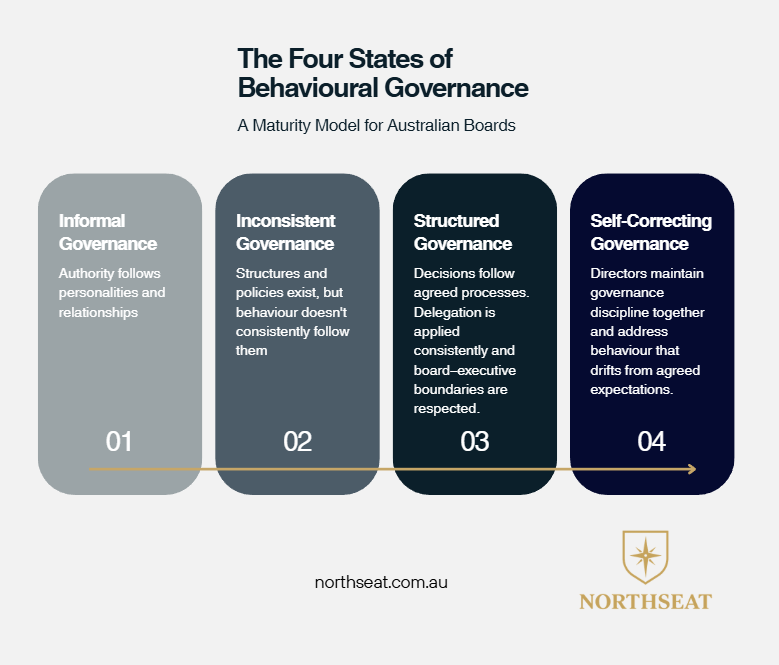
The Four States of Behavioural Governance is a model for the second question.
The Pattern Most Boards Don’t Have a Name For
Many boards operate in a specific behavioural state:
- Governance documents are in place.
- Directors interpret authority differently.
- Decisions continue in conversations outside the meeting.
- Strategic discussion drifts into operational detail.
- Boundary breaches are corrected, then repeated.
- Committee recommendations are re-opened at board level.
- The board looks structured. Behaviour varies between meetings.
Boards in this state often think: This is just how governance works.
The Four States model identifies this as Level 2 - Inconsistent Governance.
It is the state most likely to be mistaken for maturity.
The Four States
Level 1 - Informal Governance
Authority follows personality. Decisions move through relationships.
Level 2 - Inconsistent Governance
The documents exist. Behaviour varies between meetings.
Many boards operate here.
Level 3 - Structured Governance
Decisions follow agreed pathways. Delegation is applied and board–executive boundaries are respected.
Level 4 - Self-Correcting Governance
Directors maintain discipline together. Behaviour is corrected without relying on the Chair every time.
Which state is your board operating in?
What’s in the Download
Full descriptions of all four behavioural states across authority, role boundaries, decision flow, information quality, and behaviour
Diagnostic questions to help directors recognise their board’s current state
Regression indicators showing how boards move backwards
Progression indicators showing what changes between levels
About NorthSeat
NorthSeat builds governance and decision frameworks that make judgement, authority and risk explicit while options still exist.
Our products are designed for boards that want governance to shape decisions, records and role boundaries.
The Four States model is free because its purpose is recognition. It gives directors language for a pattern many boards experience before they have a way to discuss it.
How to Engage with NorthSeat
Step 1 - Diagnose Your Board’s Behavioural State
Identify whether you are in State 1, 2, 3, or 4.
Step 2 - Diagnose Your Board’s Governance Discipline
A self-directed diagnostic that examines whether governance discipline operates consistently in board decisions (level 3) or only on paper (level 2). $649 ex GST